How molecules pick a side
This year's chemistry Nobel went to Henri Kagan and Kenso Soai for work on molecular handedness. The part I wanted to understand was how a reaction can start with almost equal amounts of two mirror images and end up strongly favoring one.
The mirror image part is easier to see with gloves. A left glove and a right glove have the same fingers, thumb and palm, but turning one around doesn't make it fit the other hand. Some molecules have the same problem: the atoms and connections match, but their arrangement in space is different.
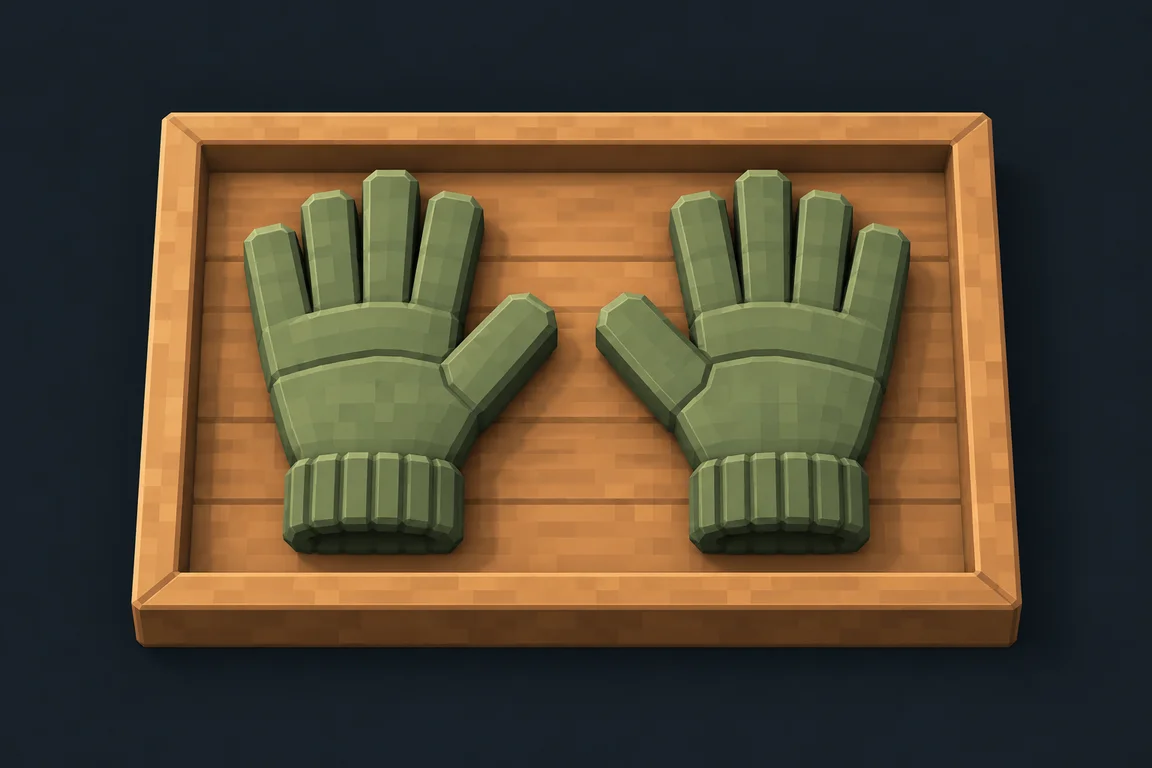
Same parts, different shape
That property is called chirality, and a pair of molecular mirror images are called enantiomers. Alanine, an amino acid, is one example. Its central carbon has four different groups attached, which can be arranged in two ways that no rotation will make identical.
The model below lets you turn one arrangement and pull the groups apart. The letters stand for real chemical groups, so you can also inspect what each piece contains. The point is to follow the same groups around the center, rather than treating the mirror images as different ingredients.
Four different groups surround the central carbon. Turning the mirror image cannot make all four line up in 3D.
Pulling the groups apart gives you a better look without breaking any bonds. Each colored piece represents a group.
About this molecular model
This is a schematic of neutral alanine, not measured atomic geometry. Alanine commonly carries charges in water. The letters identify the groups so you can follow their positions even when their projections overlap.
This matters because the things a molecule interacts with can be chiral too. An enzyme has a particular shape, much like a glove, so two mirror versions of a molecule can interact with it differently. Which one is useful depends on the molecule and what it's interacting with.
When a small preference gets bigger
A catalyst speeds up a reaction without being used up overall, and a chiral catalyst can favor one mirror image over the other. I'd expect mixing the two versions of a catalyst to weaken that preference in a pretty straightforward way. Kagan and his collaborators showed that the relationship can be more complicated.
In some reactions, a modest imbalance in the catalyst mixture produces a much stronger imbalance in the product. That's a positive nonlinear effect. That doesn't happen in every reaction, because it depends on how the catalyst molecules come together and react.
Soai's work adds another piece: the product helps catalyze the reaction that makes more of itself. In the reaction his team reported in 1995, an alcohol with a small initial excess of one mirror image led to more alcohol with an increased excess. As more of it forms, it helps make the next round.
But making more of yourself isn't enough on its own. If both mirror images simply grew in proportion to how much was already there, a 51 / 49 split would stay 51 / 49. Amplification needs chemistry that changes that balance. Research on the Soai reaction connects this to how the molecules assemble into catalytic groups, with groups of matching handedness behaving differently from mixed ones.
Each click starts a new batch with the mix from the last one. In this example, the more common shape gets a stronger advantage, so a small lead grows each time.
Start: 51% A and 49% B. Repeat the feedback to see what that mix produces. Without the extra advantage, the starting ratio stays the same.
Each square is about 1% of the mix, not one molecule. This is an example of feedback, not a simulation of the Soai reaction.
What the model assumes
For the next batch, the two shapes get weights equal to their current shares squared. If A has share p, its next share is p² / (p² + (1 − p)²). Feeding that result into another fresh batch amplifies a small imbalance. Equal growth leaves p unchanged. This rule leaves out reaction rates, limited ingredients and how molecules group together. With no random variation, it cannot pick a side from exactly 50 / 50.
Try starting exactly even, then giving either side a small advantage. The model uses a simple feedback rule to make that difference easy to follow. It doesn't predict a real reaction, and the squares changing color represent new batch proportions, not existing molecules flipping into their mirror images.
What this says about life
The larger question is why life uses such consistent molecular handedness. The chiral amino acids used to build proteins are overwhelmingly of the L form, while the sugars in DNA and RNA have the D form. Glycine, another amino acid, doesn't have a handedness at all.
An amplifying reaction gives us a way for a small initial imbalance to become much larger without someone choosing every molecule. That still doesn't tell us what started the imbalance on Earth or whether anything like the Soai reaction happened there.
That's the part I find interesting. We can explain how a small preference grows even if we don't yet know where it started.
Sources
- Tokyo University of Science on Soai's Nobel, shared with Kagan.
- Kagan and collaborators' 1986 paper on nonlinear effects.
- Soai and collaborators' 1995 paper on autocatalysis and amplification.
- Structural work on the Soai reaction explains why the molecular assemblies matter.
- Chemical mechanisms of prebiotic chirality amplification discusses the link to life's handedness and its limits.